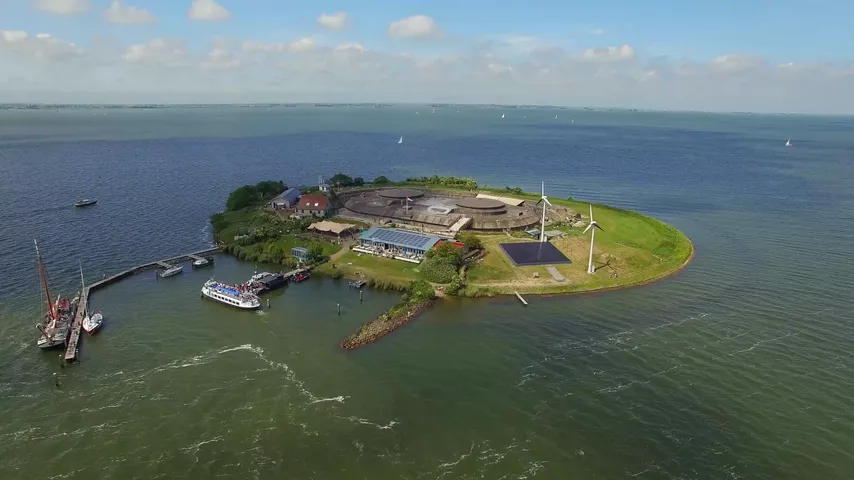
Pampus island is redefining renewable energy
Some of the most remarkable renewable energy projects take place in remote locations. When there’s no grid to rely on, the technology being used to provide power simply has to work. There’s no other option.
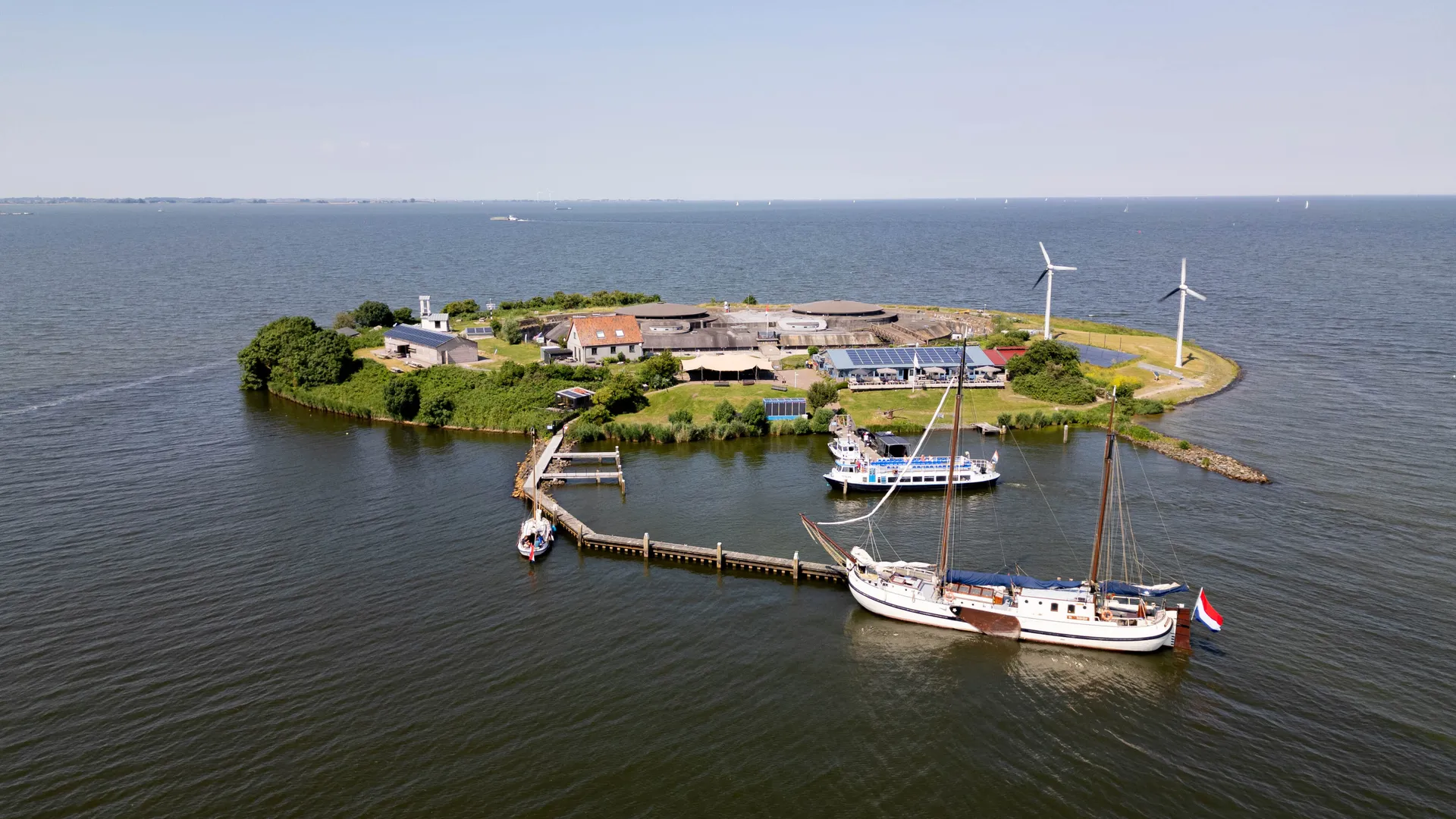
This is the case with Pampus, an island just outside of Amsterdam that’s home to one of the most innovative and interesting green energy technologies in Europe.
Here, a small island housing a museum and restaurant is powered entirely by renewables. It’s a living, breathing experiment in energy innovation — and is a testbed for the amazing power of nature. While much of the technology being used is well-known and tested by itself, what’s remarkable about the project is how these units are used in tandem with one another to power the whole location.
Pampus’ mission goes deeper than that though. By taking on this experiment, the island wants to work as a blueprint for how other places can build truly resilient renewable energy systems, no matter where they are in the world.
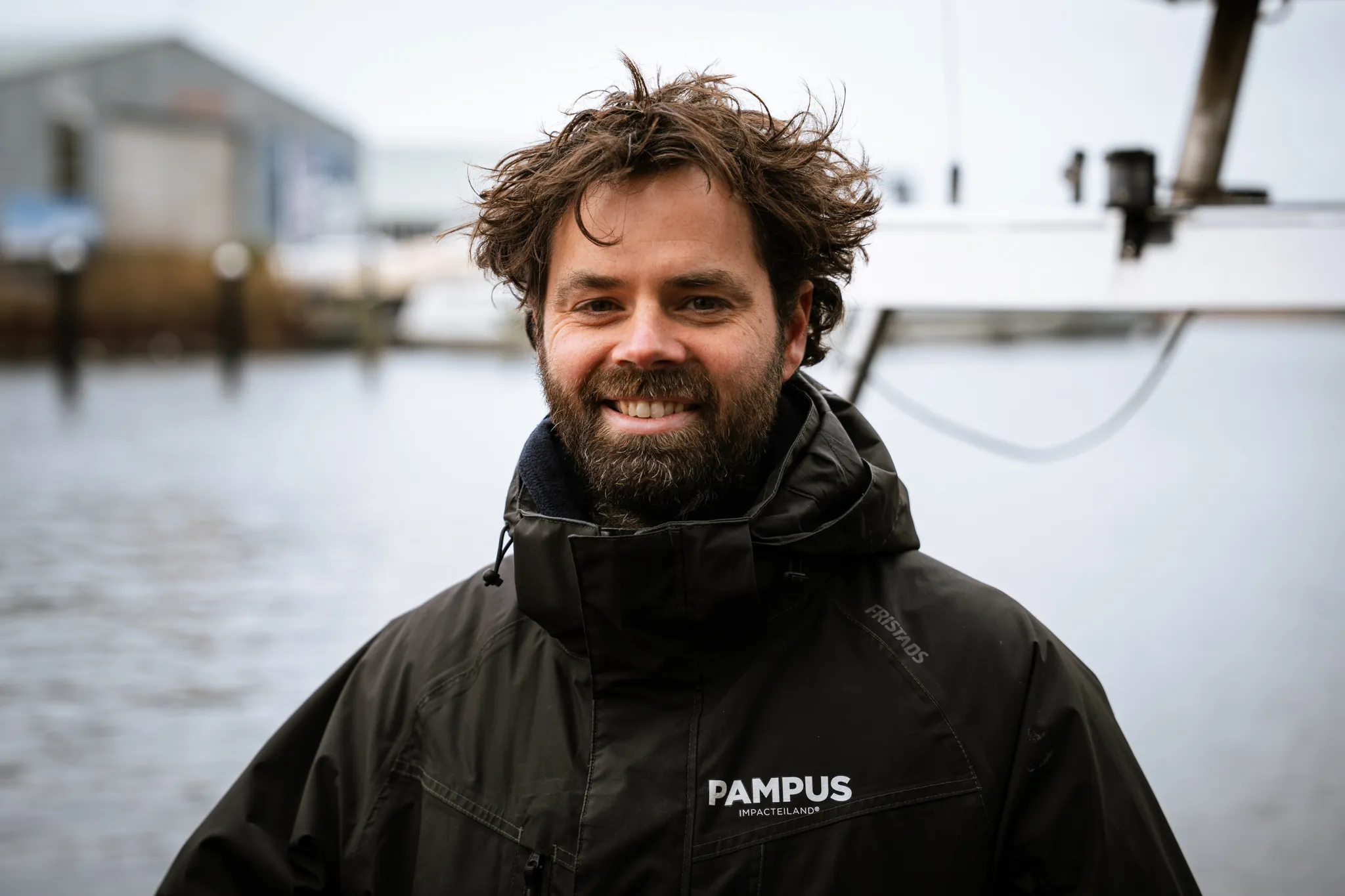
Here at Foundation⁰, we visited the project and spoke with Martin Verweij, the technical manager of the Pampus island foundation.
What is Pampus island?
To understand Pampus island’s approach to renewable energy, we need to go back to its genesis and tell its whole story.
“The island was built over 130 years ago (between 1890 and 1895) as part of the defence line around Amsterdam,” says Verweij. It was constructed as a fortress and part of the Stelling van Amsterdam, a military protection for the city. In order to slow or stop armies advancing on the Dutch capital, 45 forts were constructed, as well as a series of dams and dykes that could be used to flood the land in case of an invasion.
Although Pampus was one of these forts, it was actually built on what was then the Zuiderzee. “It was quite inventive,” Verweij tells us, as, at this point in the 1800s, land reclamation was nowhere near the sophistication of today’s standards. Building a small island was a much rarer undertaking in those days.
The military history of Pampus also has a fascinating connection with its modern function: self sufficiency. Because Pampus was designed to withstand long sieges, it meant 200 soldiers could live for about three months on the island with no outside contact. The base included a steam engine that didn’t only run the cannons, but also provided electric lighting in the fortress.
“This was really new,” Verweij says, as “most of the soldiers stationed on the island used candles at home and had no clean water. It was a really high tech island back then.”
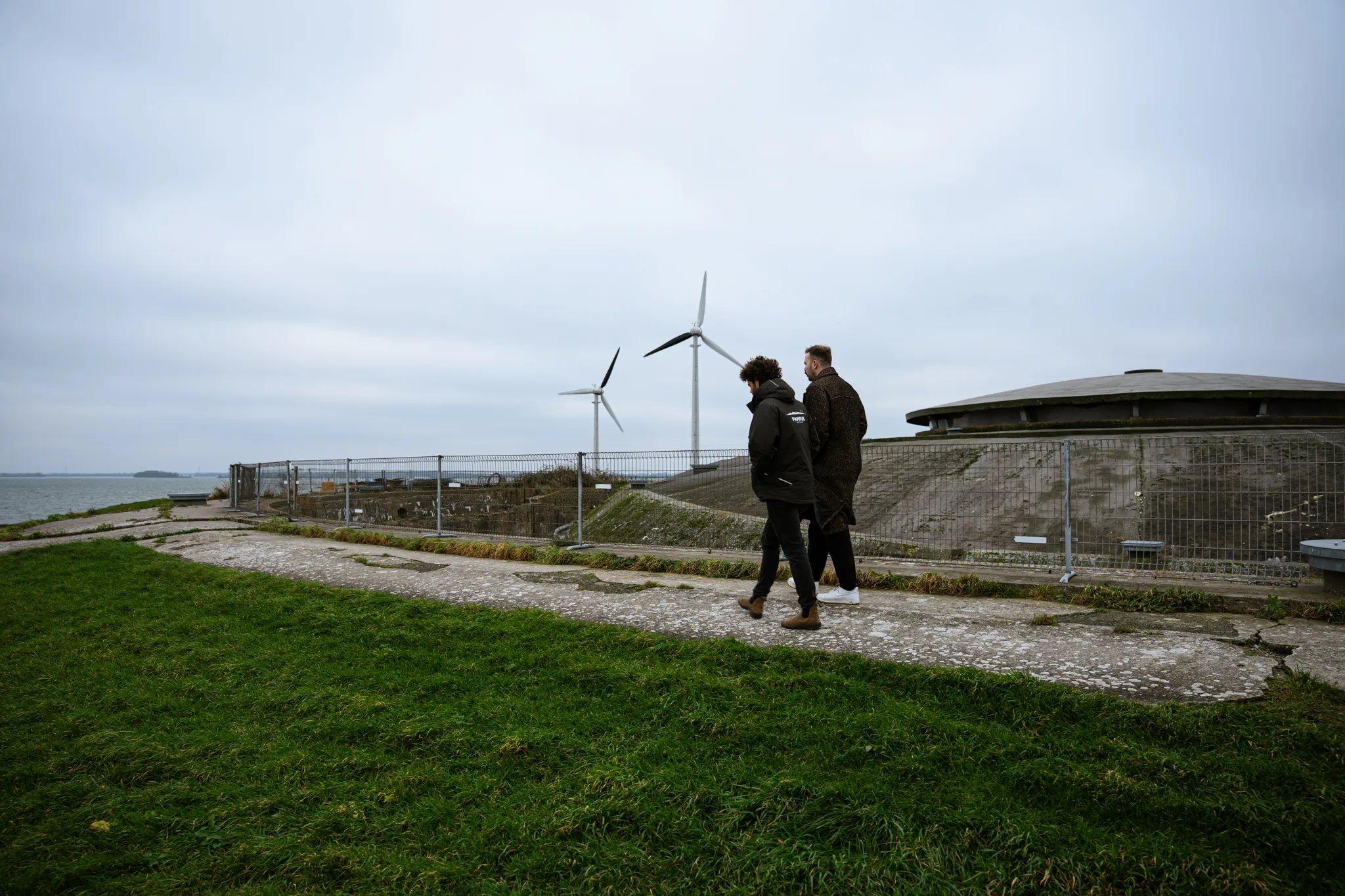
As technology evolved though, Pampus was outpaced. Soldiers were stationed on Pampus island during the First World War, but the nature of conflict moved quickly in the 20th century. Planes entered common use. Forts were no longer a reliable form of defence. Combine this with the construction of the Afsluitdijk in 1932 that created IJsselmeer (which stopped ships travelling towards Amsterdam), Pampus became militarily obsolete by the Second World War. The only action it saw during that period was from German soldiers. They built a listening post for planes, but as they flew more north than Pampus’ position, the project was quickly abandoned. Following this, the island was stripped of metals.
What followed were several years of neglect, with Pampus largely forgotten. This changed in the 80s though. “Volunteers restored the island,” Verweij says, “slowly we became more and more professional. Now, there's about 25 people working at Pampus and we rely on another 100 volunteers.”
The island grew from a dream into a fully functioning community centre. It has a museum and a restaurant, but arguably the most interesting element is how it powers it all.
The future of energy, today
“I’ve been working at Pampus since 2017,” Verweij says, and “I've been busy with the project of creating an energy system that doesn’t use fossil fuels since I started.”
Supported by a € 1 million grant from the EU, the project integrates wind, solar, and biogas — harnessing everything from sun and wind to the kitchen’s organic waste. The rationale in going this route is two-fold: convenience and heritage.
Because it’s an island that’s only reachable by boat, it’s not connected to the grid, something that’d be inordinately expensive to hook up and in conflict with history. The other option would be carting fossil fuels over to the island (something that happened for over 30 years), but focusing on renewables is more future proof, protects the world for future generations, and ties into the location’s heritage. Pampus has a history of self sufficiency, it was built to be somewhere that could operate alone, so embracing renewable energy is in its DNA. This was the route it had to take.
The problem, of course, was turning this vision into a reality. To do this, they had to go back to the drawing board. The team worked out that Pampus island requires around 180,000 kWh a year for its energy usage, so this meant some pretty impressive technology was needed — especially if it was going to be resilient enough to handle different weather conditions and seasons.
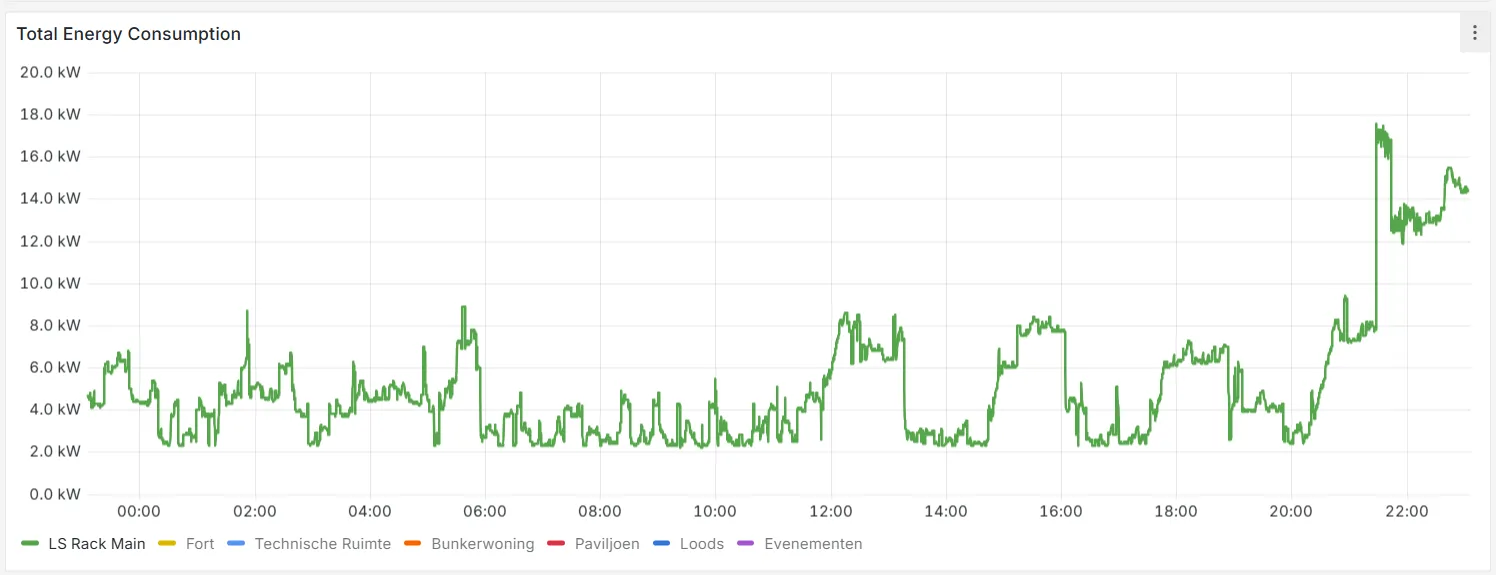
After careful research, this was split into three main sections: generation, storage, and conversion. Let’s dive into them and how they work.
Energy generation
Without the backup of the grid, there needed to be redundancy built into the energy generation system. In other words, there needs to be enough ways to create power no matter what the weather is going. This led to Pampus having four methods of generation: wind, solar, thermal, and organic waste.
One of the most striking elements of Pampus are the wind turbines. These two 15-metre high windmills are capable of generating 15 kW in a single hour. In 2025, the wind turbines produced 46.33 MWh, while in 2024 this figure was 46.76 MWh, showing the consistency of this method.
Another aspect is the solar energy, consisting of 144 solar panels in a field, 92 on a warehouse roof, 72 on the restaurant, and nine on the toilets, creating a total of 113 kW of solar. Last year, total solar production was 55 MWh, which worked out to be the prominent producer of energy on the island.
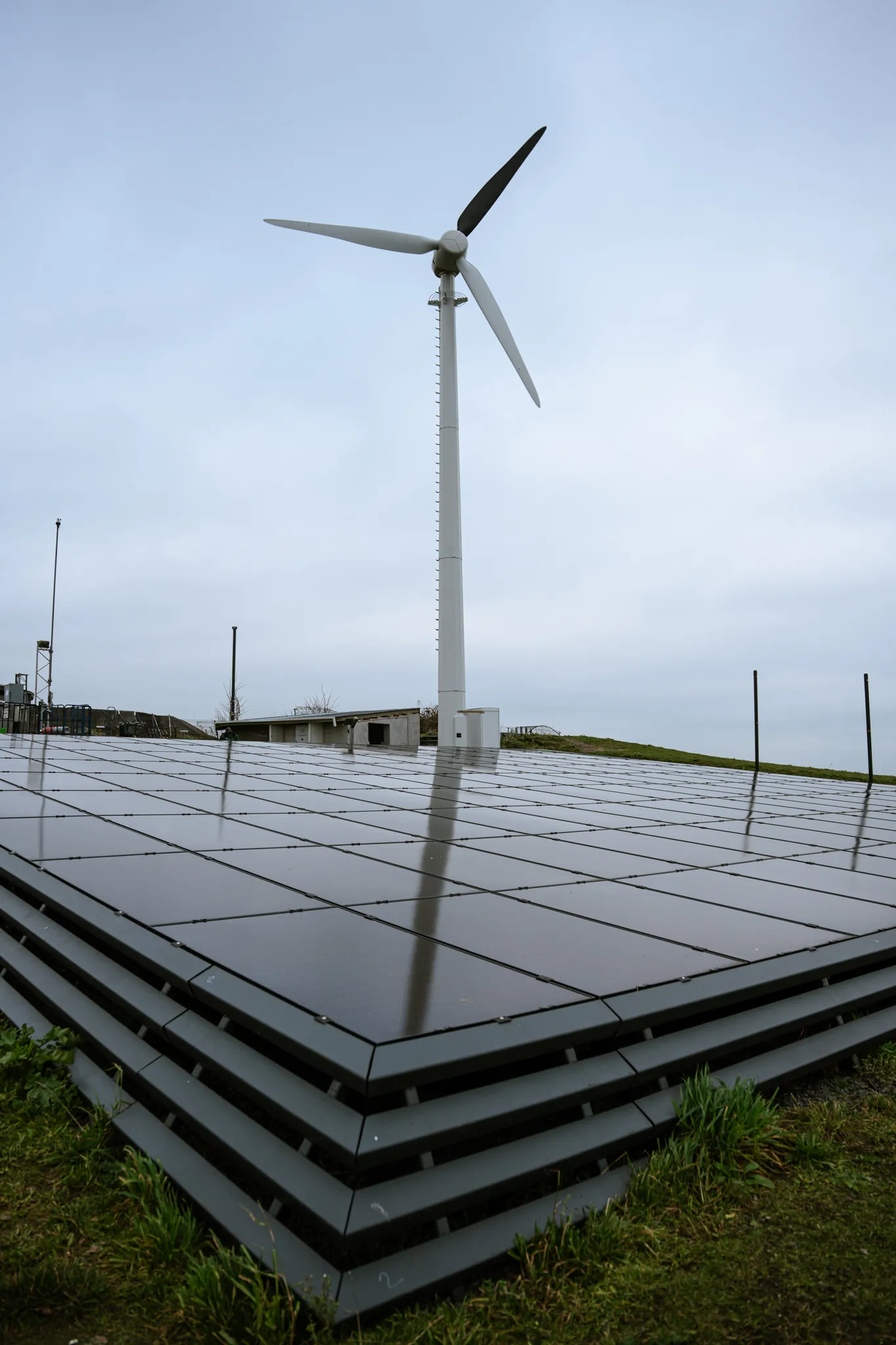
Underneath some of these solar panels are special collectors that draw heat in from the sun. This area is normally a few degrees warmer than the outside surroundings, so makes it ideal to draw on this resource.
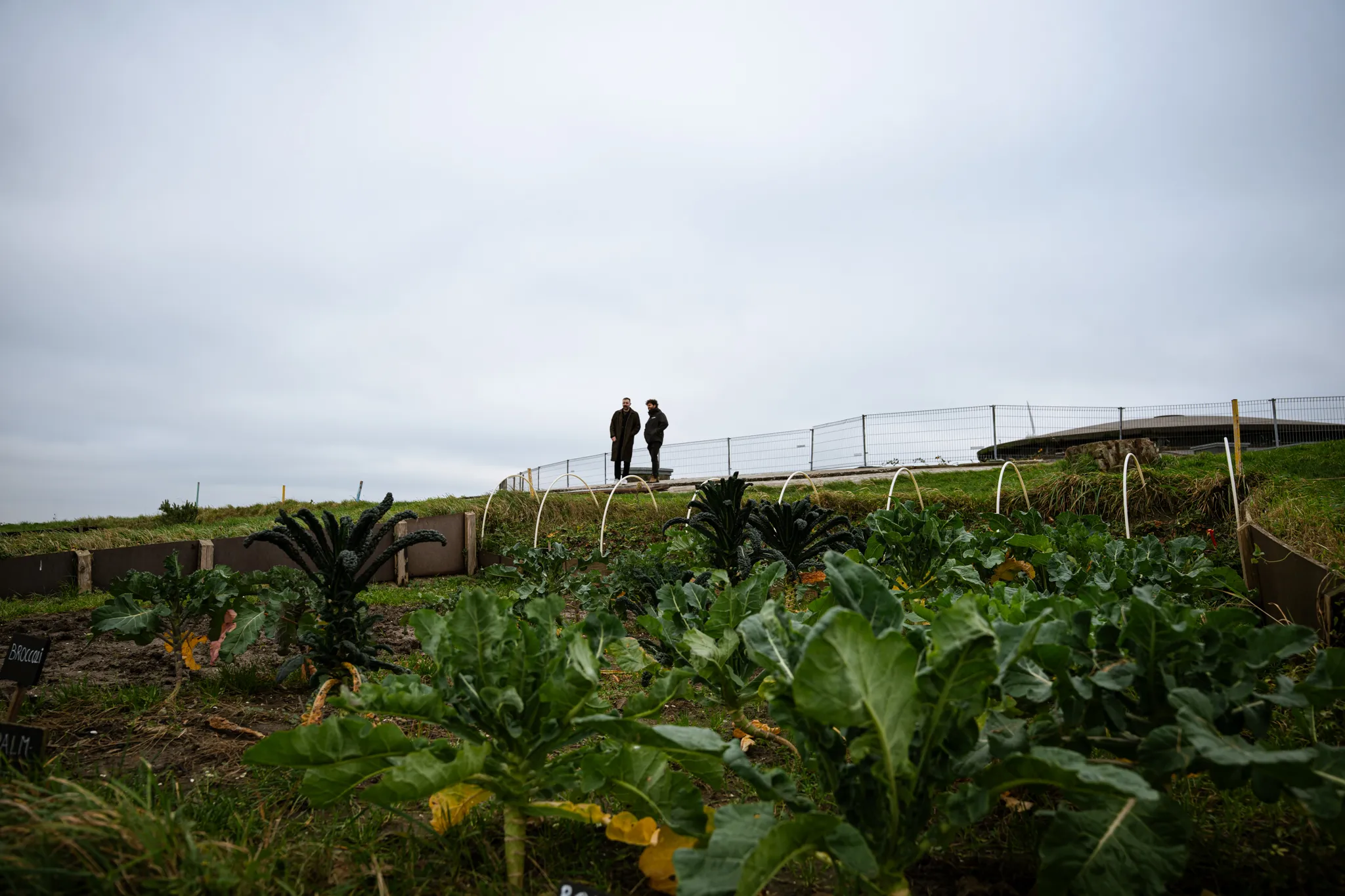
The fourth and final type of energy is organic waste. Here, a biodigester can help convert organic waste into biogas. The kitchen trimmings and food scraps can produce up to 30 kg to 50 kg of waste per day, and this gas can be used for the barbeque or stored for winter.
Theoretically, this produces 5 to 9 m3 biogas every 24 hours.
There is an issue though. Because Pampus island is a heritage site, the team is limited in how many structures they can build. Building more wind turbines or installing more solar panels simply isn’t possible, which is why storage and conversion is vital.
Energy storage and conversion
The other key part of the energy puzzle at Pampus is storage and conversion. This is a key element in being able to host people all year around.
“In summertime, you have a surplus of energy, especially from the solar panels,” says Verweij. “There’s a lot of energy and you want to store it.” This can then be used in winter — a time where there’s less solar production and a larger heat demand — to ensure Pampus remains functional throughout the year.
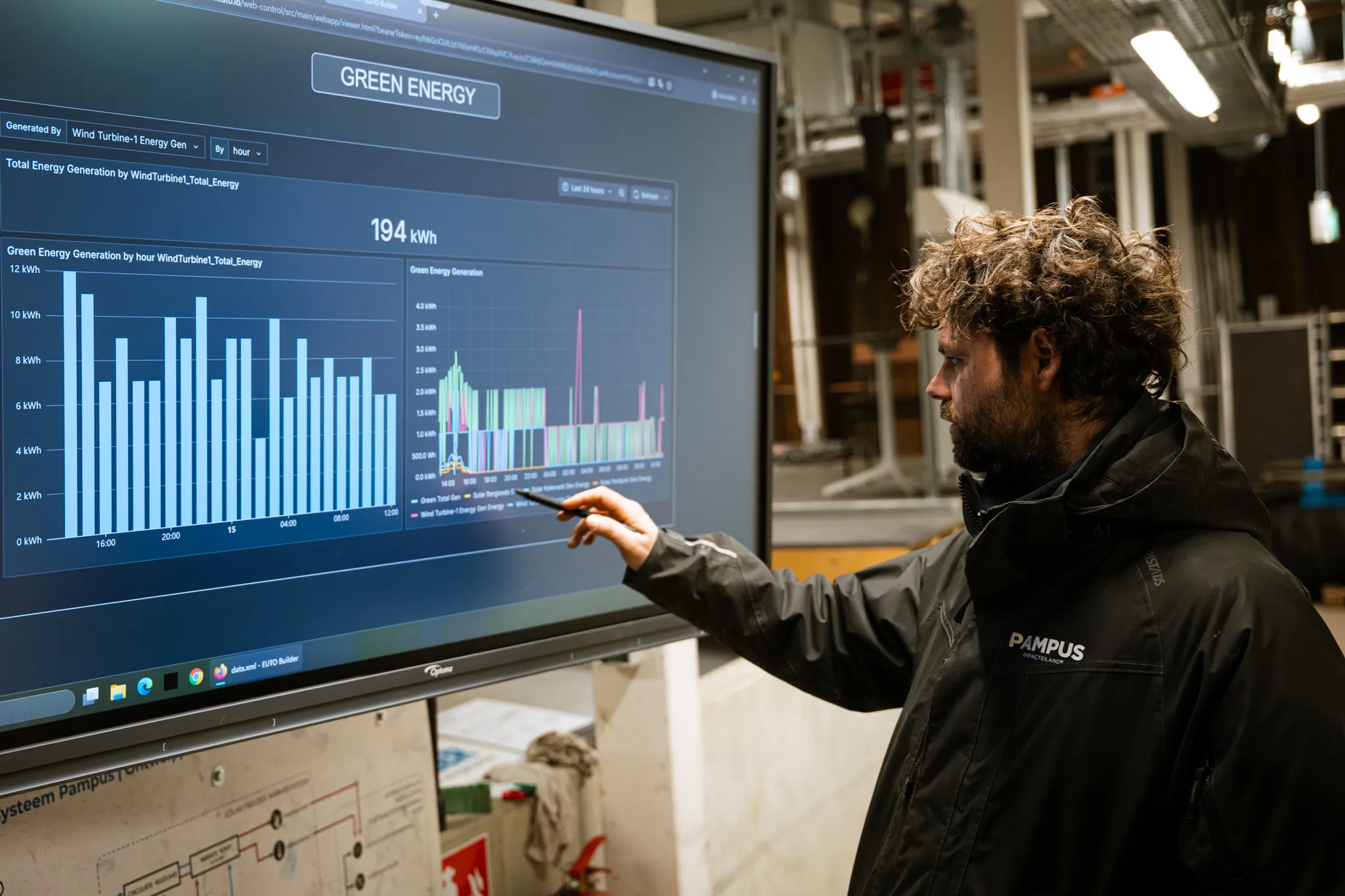
The key component of all of this is the 376 kWh battery. “We have a lithium iron battery, which is the main power source,” says Verweij. The solar panels and wind turbines often produce more energy than is needed at a specific moment, so this ensures that can be spread across the days.
The next part is the electrolyser. When the battery is fully charged and there is an excess of energy — say on a very windy day — the electrolyser can use this excess (combined with water) to make hydrogen. This is stored in six tanks, which would be 246 kg Hydrogen under pressure of max 300 bar. This is the equivalent of 8,118 kWh.
“We can produce 8.5 kg of hydrogen every 24 hours,” Verweij says, “So we need about 100 days of 20 kW overproduction of green energy to fill up the entire buffer.”
When solar and wind energy don’t produce enough to power the island (in times such as winter), a fuel cell converts the hydrogen into water, a process in which heat and energy are released. This consumes about 1 kg of hydrogen per hour, producing 15 kW of electricity and 20 kW heat. The electricity goes back into the lithium iron battery and the heat is used to warm up the buffer tanks, of which there are two that can hold 20 m3 of water. Combined with the 8 kW heat pumps, these can then be used to heat the building.
Alongside this, the heat collected from underneath the solar panels are stored in water bags. These can be cooled down to freezing temperatures by heat pumps extracting heat. This is then stored in the buffer tanks with the aforementioned heat from the fuel cells and the Combined Heat and Power (CHP) unit.
On that note, when the stored biogas is required (for example if there’s a need for additional energy) biogas is burned by the CHP unit, which produces electricity on top of the heat.
Challenges, collaboration, and the future
While the individual technologies themselves are proven, their integration has not been without hurdles. Making diverse systems — and the companies behind them — communicate and collaborate smoothly remains an ongoing trial. Maintaining momentum and knowledge transfer is also a challenge, as Pampus’s main revenue stream is hospitality and education, not energy generation.
This has meant that some elements of the system aren't working as well as they would like, with the biodigester not always operational and the hydrogen systems not fully functioning yet either. Some individual systems have teething problems, but the next step is to ensure all these different elements are connected and operating together.
Because Pampus island is limited by heritage constraints and can’t build any more solar panels or wind turbines, the goal is creating a system integrator. “This system must make careful choices based on data about which sources we use and, above all, estimate when we will truly run out,” Verweij says. Installing this is the next step in the Pampus island project.
Thankfully, the team looks ahead with ambition: “Our real goal is to get everything working as envisioned, to learn from it, and to share those lessons with others — universities, schools, and future clean energy projects,” explains Verweij.
The team doesn't want Pampus to be, quite literally, an island. All the learnings they’re gathering they aim to put in reports and share with the entire industry.
Ultimately, for renewable energy to change the world, it won’t be a straight line. People and projects need to take risks to try and make it work — which is exactly what Pampus island is doing. And, in the process, it might just provide the blueprint for a real energy revolution.