Designing the water system for a yacht powered by renewable energy
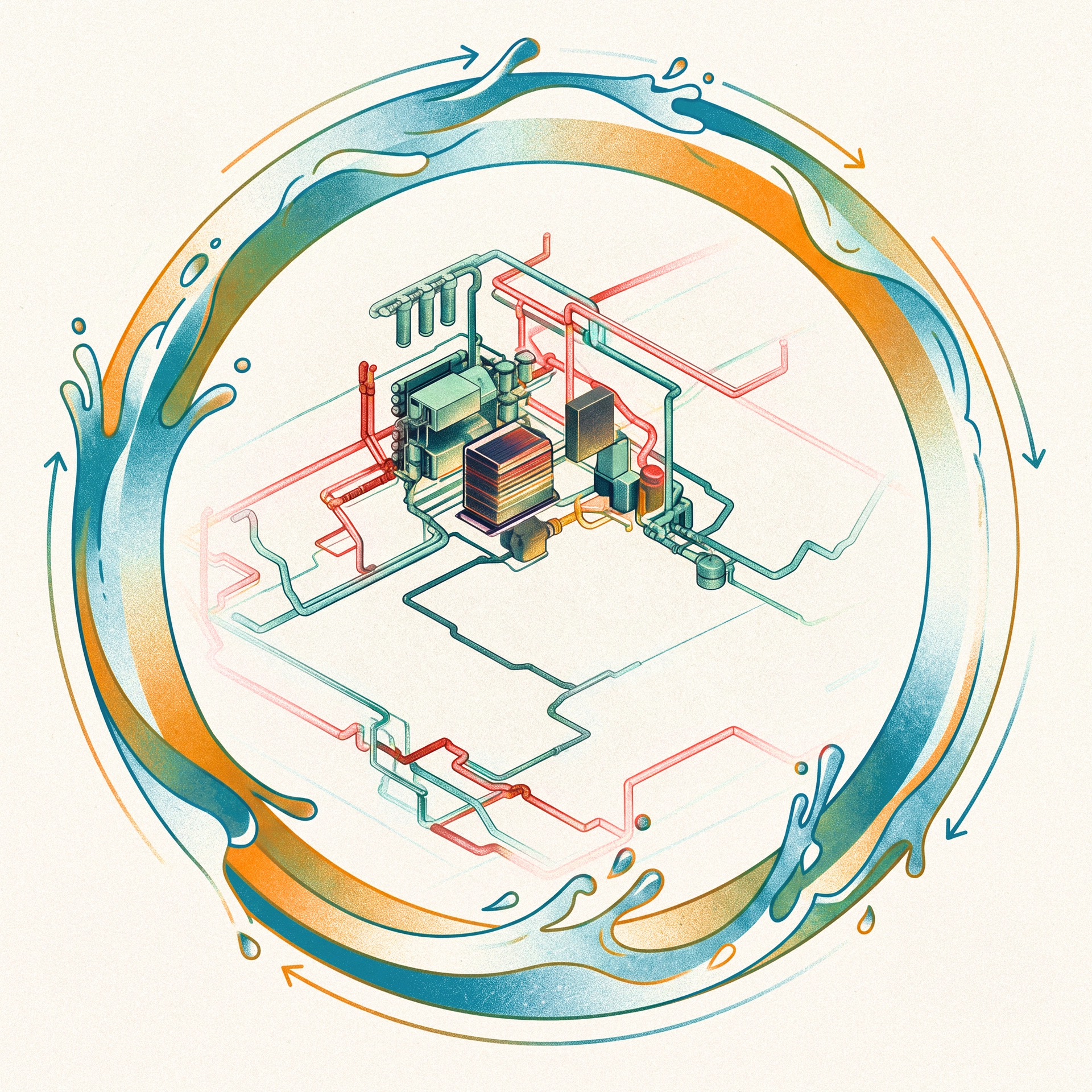
When designing a vessel that relies entirely on renewable energy like sailing yacht Zero, you have to embrace an entirely new type of thinking. Energy is no longer a point of background discussion, instead it fires into the forefront of each and every conversation.
This approach is neatly summed up by Eduard van Benthem, the project manager of sailing yacht Zero: “The goal of the systems is to minimise their energy usage, all without compromising comfort for the crew and guests.”
To reposition that, it means careful and clever energy management. Not only in storing and harvesting energy, but also reducing how much is used.
For the water system, this included a series of concrete concepts:
- Making water treatment, production, and distribution as energy efficient as possible, from selecting the correct components to altering how piping around the ship operates.
- Reducing fresh water consumption across the entire vessel.
- Sourcing technical water from rain and fan coil condensation to replace fresh water use with technical water wherever possible.
- Gathering data for developing a new benchmark and insights on energy use on board for the future.
Analysis was key in this journey. “There were few benchmarks or data available for actual energy usage in these types of yachts, meaning it had to be built from scratch,” Van Benthem says.
This identified the main energy consumers within the system, such as the water maker itself, showers, and the deck wash.
In addition, the team recognised fresh water as a form of energy buffer: when surplus energy is available on board from, say, hydrogeneration or solar power, producing and storing water becomes a way of storing that excess energy. This is why Zero has a huge volume of water tanks, with two 10 ton units.
Choosing the right water maker
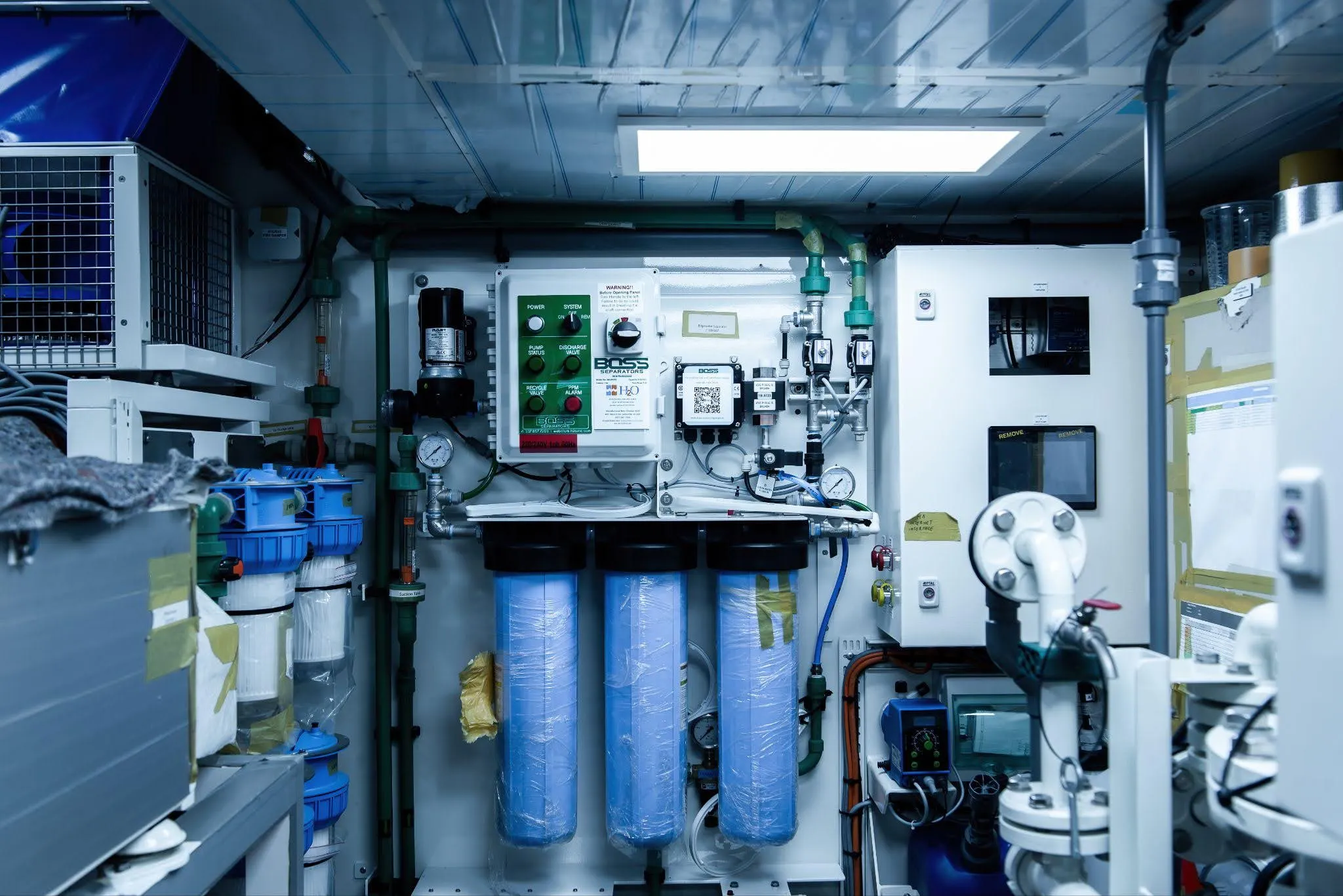
A key part of this process was looking at one of the main consumers of the system: the water maker. Van Benthem described the overriding question behind this process, simply, as “what technologies and approaches can make this as energy efficient as possible?”
A new approach to making water
Energy recovery on high-pressure was an important decision-making factor. Most water makers are Reverse Osmosis (RO) systems. In these, as part of the desalination process the pump has to work hard to push saltwater through a membrane.
“Usually, a lot of pressure energy is wasted when leftover brine is discharged, but energy recovery on high-pressure helps rectify this,” he says. “The energy recovery on high-pressure technology captures some of this leftover pressure and uses it to help pump the next batch of water. This significantly reduces the energy needed per m³ overall.”
The team eventually selected a Spectra water maker. This was more energy efficient, coming in at 3.3kWh per m³ (far lower than the industry standard of 10 kWh per m³) and hit the highest number of their requirements.
Yet Van Benthem explained that other elements needed to be taken into account. For example, on a sailing yacht selecting a water maker means balancing size, weight, reliability, availability of spare parts, and the worldwide serviceability of the unit.
This led to research, which you can can view in the table below:
| Type | Capacity | Consumption | Kwh per cubic meter | Power consumption for needed FW capacity* | Weight |
|---|---|---|---|---|---|
| Unit A | 454 | 1500 | 3.3 kWh | 15 kWh | 166 |
| Unit B | 1575 | 5000 | 3.2 kWh | 14,5 kWh | 725 |
| Unit C | 2x 150 | 2X 600 | 4 kWh | 18,2 kWh | 2x 61 |
| Unit D | 625 | 6600 | 10,56 kWh | 48,1 kWh | 202 |
Prioritising the technical water system
Desalinating water is energy intensive, this we’ve mentioned. But an intriguing way to cut down on this is to find areas of sailing yacht Zero that don’t need such high-quality water.
Summing this up, Van Benthem says, “we focused on sourcing technical water, as purifying an already salt-free water source requires significantly less power than desalinating salt water.”
In regards to collecting technical water, the main source is rain collection.
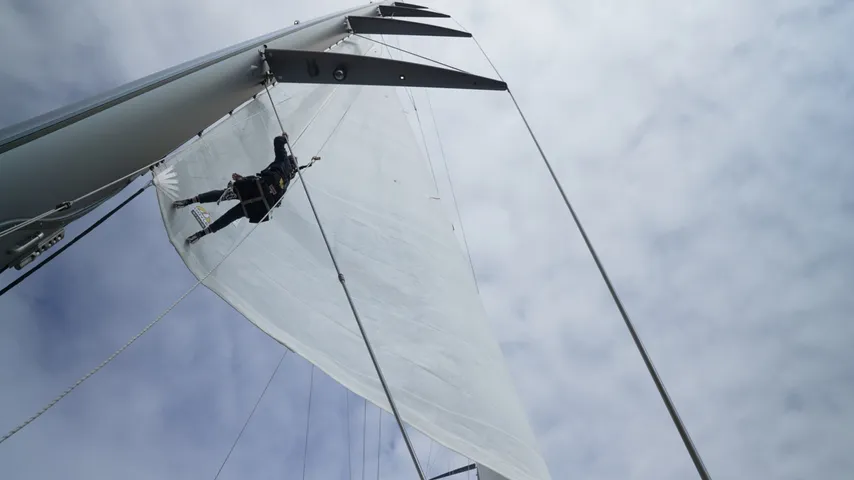
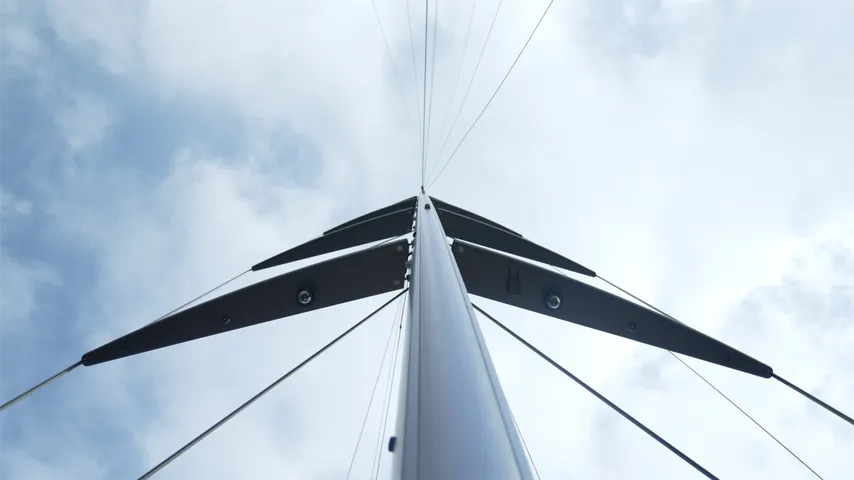
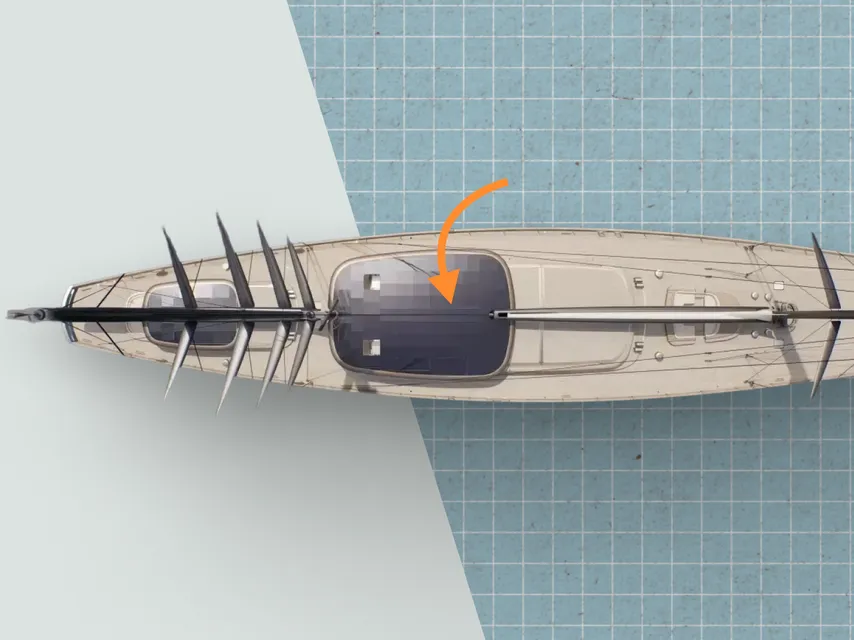
“The boom will collect water from the sails and runs it into the foot of the mast,” Van Benthem explains. “The crew has to hook up the collection when it rains, with a first-flush bypass, as the sails are salty and this needs to be run off.”
He’s keen to point out though that this is still in a proof-of-concept stage and will need proper testing when sailing yacht Zero hits the water. Especially as rainwater collection performs and provides value under different weather scenarios.
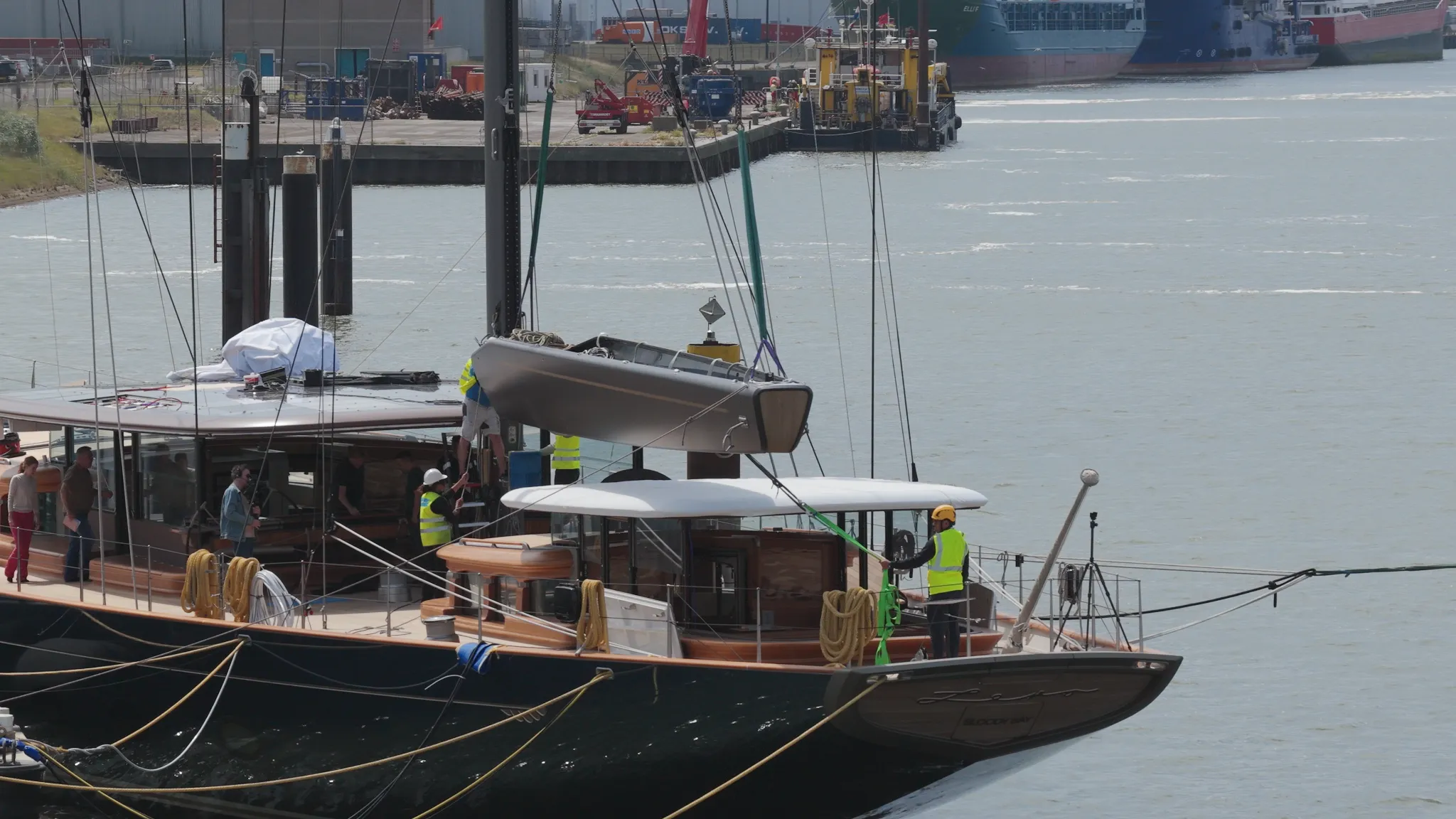
“Hydrogeneration when sailing generates far more energy than is saved by relying on collected rainwater,” Van Benthem says, “so the collection system may be particularly valuable when the boat is at anchor or in port.”
Alongside rainwater, the system also collects air conditioning condensate from fan coils. Normally, this water is drained overboard, but it’s collected into a tank instead.
“This modification was not particularly complicated, we merely added a collection tank and redirected the condensate from the drain to the tank.”
What this led to was the design of a separate circuit running on technical water, therefore reducing the load on the water maker.
The two main areas this services are the deck wash and the adiabatic cooling systems. Other elements were considered such as the water for flushing the toilet, but these weren’t implemented in order to avoid overcomplicating the system, as well as little gain.
“It’s always a balance,” Van Benthem says, “between reliability, feasibility, and savings.”
The road to reducing water consumption
Another approach towards minimising energy usage onboard sailing yacht Zero is reducing the amount of fresh water consumption altogether.
“The useful part of this is that many of these technologies already existed on land,” Van Benthem says, “it was just about finding them and adapting them for the marine environment”
Toilet flushing
A standard flush uses about five litres of water, but this was reduced to 3 litres by selecting the right manufacturer and system from land use.
Galley
The team also looked for water savings in the galley, but research showed the potential was minimal.
According to Van Benthem, galley water volume is insignificant compared to guest showers or deck washing. Furthermore, while flow restrictors could reduce usage, they hampered the chefs' efficiency. Ultimately, the team decided not to sacrifice functionality for negligible gains in this case.
Deck wash
“Deck wash is a significant consumer of water, as it’s used in large volumes to remove salt and fumes that collect on the lacquering of many yachts,” Van Benthem says, “especially because salt deposits are more visible on high-gloss surfaces.”
Some possibilities for reducing consumption included using a high-pressure, but low-volume washer. “This would use less water but we decided not to pursue this now because it wasn’t practical for the crew and still used electricity, which puts pressure on other parts of the energy system onboard,” Van Benthem says. “Although, this is something we will revisit in the future.”
The best way to save energy was to stop using fresh water on the deck and use technical water instead.
Saving energy with pipes, pressure, and flow
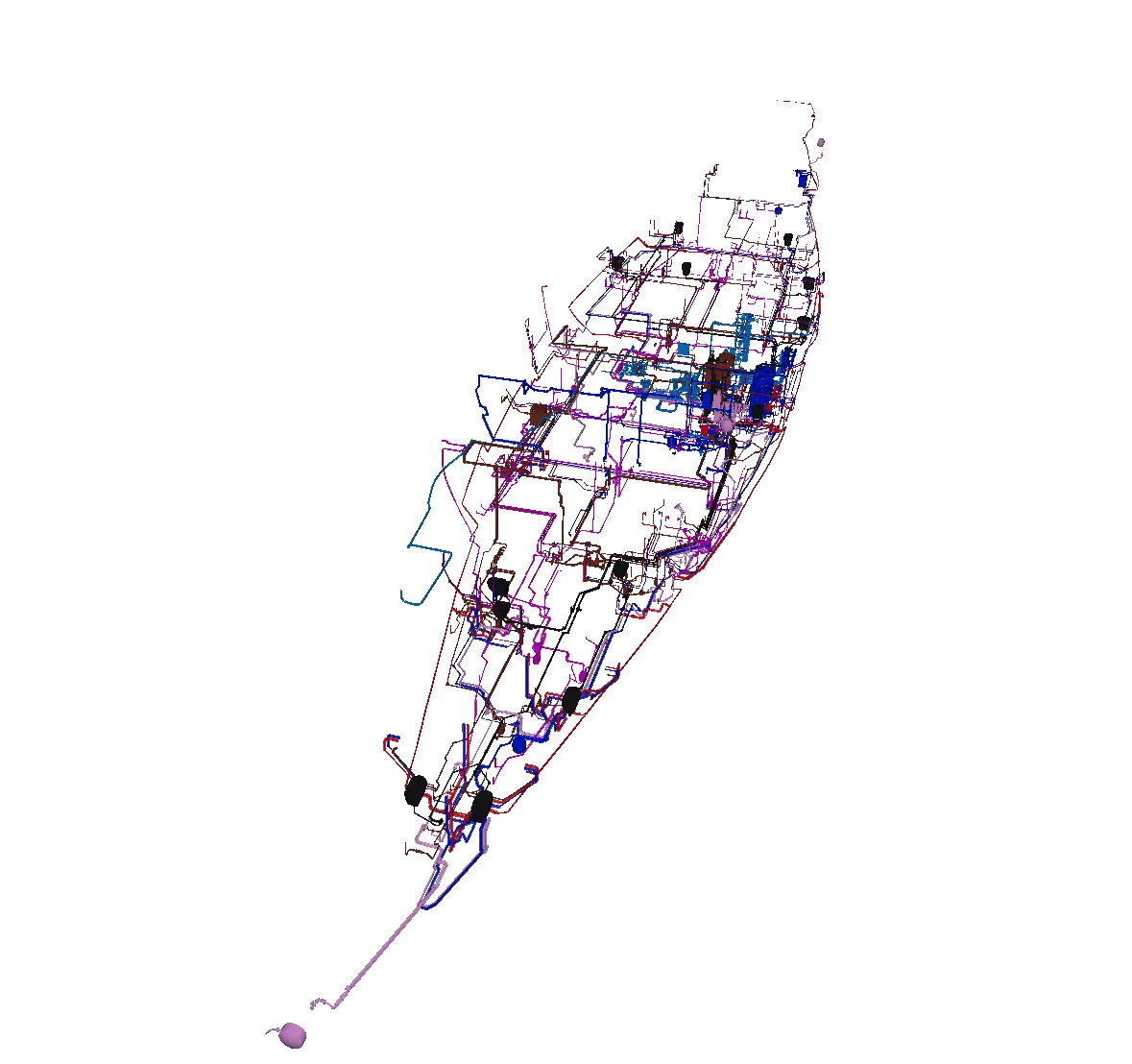
“We reviewed the standard piping and pressure system through an energy-focused lens to identify where consumption could be reduced and overall efficiency improved,” Van Benthem says.
In other words, it costs energy to move water. The team’s goal was to see what could be done to reduce this expenditure.
One avenue was the pressure of water in pipes. “When you open a tap, water pressure is released as loss,” Van Benthem explains. In residential environments, the standard is around 3 bar, but sailing yacht Zero targeted a lower figure, settling around 2 bar. This point is about the minimum of comfort. Much below this figure and it’s noticeable to guests, with the shower in particular being troublesome.
Yet, at around 2 bar, it saves the distribution pump a third of energy.
This realisation led the team to lower the pressure to the aforementioned 2 bar. To compensate for the lower pressure, the pipe diameter was increased by one size throughout the vessel, reducing flow resistance and allowing the same volume of water to be delivered with less pumping energy.
There needed to be more careful balancing though, as increasing the diameter also increases the surface area of the pipe, which directly affects energy losses in the transport of warm water — another integral part of the system.
How is hot water managed?
“The hot water used in showers and domestic equipment is generated mainly by using energy recovered from the vessel’s heat recovery system,” says Van Benthem.
He goes on to explain that a big challenge in this system was providing instant hot water at every tap. Traditional systems use a continuous circulation loop to keep hot water close to all outlets, this requires the hot water to be continuously running throughout the vessel, which leads to heat losses through the pipework, even when insulated.
“As a result,” Van Benthem says, “energy is continuously needed to reheat the water.”
To reduce these losses, he says that the vessel's hot water system is divided into two circulation loops: forward and aft. If an area of the yacht is unoccupied, such as the aft guest accommodation, that loop can be isolated, avoiding unnecessary circulation and heat loss.
Software control adds another layer of efficiency by adjusting circulation based on occupancy and usage patterns.
“During low-demand periods, such as nighttime, circulation can be reduced,” Van Benthem says, “minimising heat losses while still maintaining comfort and reducing overall energy consumption.”
The (almost) final figures of how much water will be used on sailing yacht Zero
Following all the research, this is the amount of freshwater that was calculated:
| Item | Amount of water | QTY crew | QTY charter | Total amount crew | Total amount crew + guest | Unit |
|---|---|---|---|---|---|---|
| Showers | 90 | 12 | 22 | 1080 | 1980 | L |
| Sinks | 10 | 12 | 22 | 120 | 220 | L |
| Hand washing | 3 | 12 | 22 | 36 | 66 | L |
| Galley | 10 | 12 | 22 | 120 | 220 | L |
| Deck Showers | 20 | 22 | 0 | 440 | L | |
| Total FW | 1356 | 2926 | L |
Technical water:
| Item | Amount of water | QTY crew | QTY charter | Total amount crew | Total amount crew + guest |
|---|---|---|---|---|---|
| Toilets | 18 | 12 | 22 | 216 | 396 |
| Washing machines | 50 | 12 | 22 | 600 | 1100 |
| Deck Wash | 1000 | 1000 | |||
| Adiabatic cooling | 250 | 250 | |||
| Total TW | 2066 | 2746 |
The technical water will be sourced from:
| Item | Total amount crew | Total amount crew + guest |
|---|---|---|
| Condensation HVAC | 50 | 50 |
| Rainwater | 50 | 50 |
| GW sinks + handwashing | 156 | 286 |
| Galley | 60 | 110 |
| Washing machine + dryer | 600 | 1100 |
| Total GW | 916 | 1596 |
| Total TW (70% of GW) | 641,2 | 1117,2 |
Following this, the team worked out how much more freshwater was needed to achieve the required quantity of technical water:
| Total TW | 2066 | 2746 |
|---|---|---|
| - Total TW-rec (70% of GW) | 641,2 | 1117,2 |
| Extra FW needed for TW | 1424,8 | 1628,8 |
At this stage, there were two figures. The first is based on the maximum number of crew and quests, which came to be around 4,555 L. The second is if there’s only crew on board, which came to 2,781 L.
Those are the current estimated figures of how much water sailing yacht Zero requires.
What comes next?
The water system in sailing yacht Zero is a living example of how technical structures alter when energy becomes a key decision maker.
The team had the tricky task of not only trying to cut down energy expenditure wherever possible, but also providing a level of comfort that these drops wouldn’t be noticed by guests.
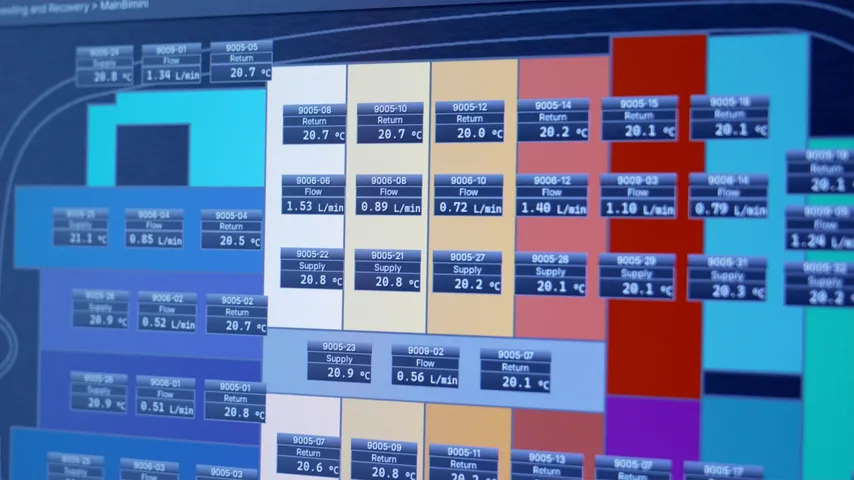
Beyond this, one of the special things about sailing yacht Zero is how much data will be collected. In the case of the water system, flow sensors are installed throughout the vessel, which will give insight into where water is being consumed.
Over time, this will produce data and information, which can not only be used to improve the efficiency of sailing yacht Zero, but also create a new benchmark for water consumption on these types of vessels.
Designing the system is just the start. Next, Van Benthem and the team have to see how it operates in the real world. They’ll use data to analyse everything that occurs on board and further develop sailing yacht Zero.
We’ll continue following this journey at Foundation⁰, so stay tuned.